


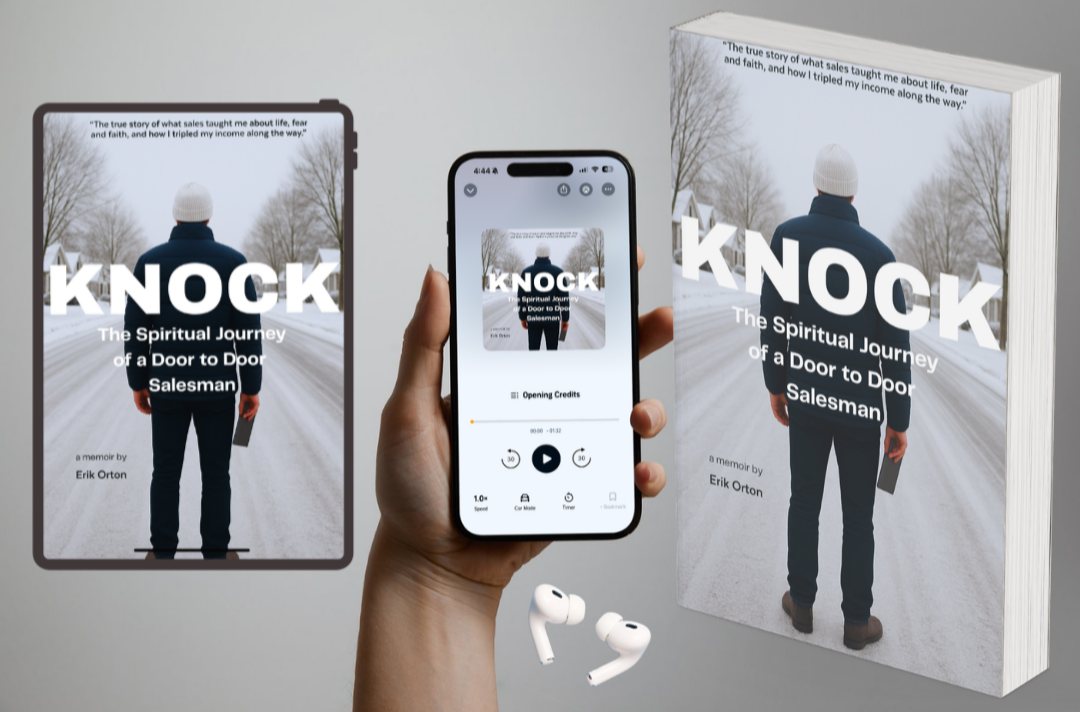
And get your free Bonus Book Bundle
Do you ever worry about money?
Do you struggle to balance work and family?
Do you wish you could do something more fulfilling?
Do you wonder if you’re missing out on the best life has to offer?
If so, this book can help.
On the heels of a life changing sailing sabbatical with his family, Erik finds himself back in his grey Manhattan cubicle doing the exact same job as before. New wine in an old bottle. Something has to change. He’s seen the other side and liked it.
When he discovers the opportunity to earn a small fortune selling solar door-to-door on Long Island, he swallows his pride and takes it. So begins a journey that leads him through fear, faith, greed, freezing feet and ultimately to love. With insight and humor scattered throughout, Erik shares the lessons he learns as he travels toward the center of his soul to discover his true purpose.
Whether you’re in sales or not, if you want to clarify your purpose, conquer fear, worry and anxiety and step into your best life, this book will show you the way.
⬆️ This is what I wrote to pitch the book.
And it's true. After living on a sailboat for a year, what happened after was even more transformative. So if you haven't already bought the book, below is your peek inside.
KNOCK
by Erik Orton
Prelude
I sat down the other day with a friend who asked about my next book. A little embarrassed, I told him, “I’m writing about when I was a door to door salesman.” It’s difficult to tell people you were a door to door salesman, especially when you started at the age of 40. He asked a few questions and I gave a few answers. I explained the book was about my journey: facing fears, overcoming insecurity, figuring out what really mattered and ultimately learning to love people. By the end of our conversation he said, “Who wouldn’t want to read that book?” As I’m fond of saying, encouragement is the greatest gift we can give each other. My friend gave me the gift of encouragement that day. I hope this book gives you the same gift.
Picking up a book reflects a trust in what the book contains. I hope to honor your trust through the next few hundred pages. Thank you for allowing me to share this journey with you.
Erik Orton
Dunedin, New Zealand
July 4, 2019
Introduction
November 2015
Thirty to forty sales reps, bundled in winter coats and boots, milled around a room full of plastic folding chairs under a low suspended ceiling and fluorescent lights. All the chairs faced the white board and Nate Champion, who stood in front of the board. I sat in the back row, my hands stuffed in the pockets of my zipped up parka, wondering what I was in for. Nate, a fit, brown haired guy in his late twenties, solemnly bowed his head and stood still for a moment. Facing the floor, he clapped his hands a single time. A pause. Another clap. A pause, then another clap. Slowly, everyone joined in. As the pace accelerated it was impossible to clap in unison and soon it was a booming applause and everyone cheered and shouted. What in the world? The clapping stopped.
“Alright everybody. Grab a seat,” Nate said. “It’s time to get started. Palermo’s gonna run us through our numbers.”
I looked around the room. It was all guys except two ladies; one sitting in the row in front of me. Everyone appeared to be in their twenties except a few guys in their thirties and one grey haired guy with a beard.
A short stocky guy with slicked back black hair and a gold chain swaggered to the white board. He brandished a dry eraser and surveyed the seated sales reps with a slanted grin.
“Alright,” Palermo said. “When I say your name tell me how many AC’s you had for the week.” His Long Island accent was not subtle. “Champion?” he continued, looking at Nate.
“Seven.”
“Two clap!” Palermo called out. In unison the whole group cupped and slapped their hands together in two thunderous claps. Not one. Not three. Two.
“Thurman?”
“Three.”
“Two clap!” The same thunder repeated.
“Stein?”
“Four.”
“Two Clap!” Again.
“Mancini?”
“One.”
No clap. Palermo wrote a “1” on the board.
“VanDyke?”
“None.”
No clap. Palermo worked his way down the list of names and across the white board. I shifted in my seat and looked left and right. Nobody else thought this was weird.
(Continued below)
Act I
Chapter 1 - No One Likes to Be Embarrassed
One Month Earlier
I was sitting back at my same desk, in the exact same chair, with my same colleagues doing the exact same job I’d done before. I’d just returned from a sailing sabbatical. My wife, five children and I had spent the previous ten months sailing from the Caribbean back to Manhattan on a fixer-upper sailboat we’d bought sight unseen. We’d called the boat Fezywig. The experience changed me, although I didn’t fully understand how just yet. My hair was long and blond, longer and blonder than it had ever been. My skin was tan. Tanner than it had ever been. And my eyes were clear, clearer than they’d ever been. I’d seen the other side.
Some bankers walked in and dropped off their job. I processed the request, as usual. I’d forgotten some of the keyboard shortcuts, but it all came back quickly. Frighteningly quick. From my desk I couldn’t see any windows, only the four eggshell colored sheetrock walls, the grey hallway that faced the glass doors in front of me, and the fluorescent lights that barely lit everything. But around the corner from my desk, at the printer, windows stood floor to ceiling. I walked back to the printer and looked out over the city. I was on the 29th floor. I could see snatches of the Hudson River between silhouetted buildings. The week prior I’d sailed up that river in Fezywig with my family. We’d made it home. I could now see for fifty miles, past New Jersey into Pennsylvania. I watched the sunset over the Alleghany Mountains. I hadn’t been in a building this tall since the year prior.
Four weeks earlier Emily and I had been up at two a.m. bailing out Fezywig to keep her from sinking. Two months earlier I’d been in the Bahamas dodging squalls and swimming in crystal clear, warm water. Six months earlier we were meeting other sailing families with kids who would become lifelong friends and change the course of our travels.
Back at my desk, another banker walked in and dropped off a job. The fluorescent lights overhead held their steady UV glow. This time I remembered the keyboard shortcuts, messengered one of the operators who came up to the front desk, picked up the job and went to their cubicle to clock into it.
I worked the “Intake” desk. Intake was where the jobs entered the Wall Street factory. My job was to talk to the banker, usually an intern or low level associate. The higher-ups never came down to our level. I looked over the banker’s notes, assessed what needed to be done, set a realistic deadline, assigned an operator to do the work and made sure it got done properly and delivered on time. I would do this thirty to seventy times a night, between 4pm and midnight, Monday thru Friday. When I wasn’t there, someone else was in my chair doing the same thing twenty-four hours a day, seven days a week except for Thanksgiving, Christmas Day and New Year’s Day. We also closed at 8pm on Christmas Eve and New Years Eve. I shared a shift with Andy. Andy and I sat side by side facing a plate glass wall with a glass door that opened into a mineshaft-like grey hallway.
“I’ll be back in an hour,” I told Andy. I grabbed my Tupperware of food, pushed back from my desk, and walked out the mineshaft. I sat in an empty conference room on the other side of the 29th floor. All the conference rooms were empty at this hour. I usually took my “lunch” break between 8-9pm. I now looked out over Central Park. The trees stood still. No breeze. The only smells in the conference room were the aroma of industrial strength carpet cleaner and the black leather chairs that spun easily on their bases. I ate my dinner and flipped through pictures on my iPhone; pictures from life on the boat. I wore my dad’s old Air Force sweater, a fitted blue wool military issue with elbow pads and epaulets. It was the only thing warm that fit me now. I’d lost twenty pounds while sailing. I’d cinched my belt down to its last hole but my pant waist still hung loose.
Trey and Jennie Björnson and their kids had made it to the Bahamas with Fezywig. She was back in warm waters. It was a win-win with Trey and Jennie. We didn’t know if we wanted—or could afford to keep—Fezywig. And they wanted to sail with their kids for at least six months, maybe a year. Leasing it to them helped get them out on the water without the hassle of buying a boat, and it bought us some time to figure out what we wanted to do.
Back at our apartment we had piles of mail we hadn’t gone through yet. All the crucial stuff had been forwarded to my parents, who scanned and emailed it to us while we were on the boat. The rest was junk mail. I tossed out the credit card offers and retail catalogues and leafed through the magazines.
Emily pointed out an article in an alumni magazine about a guy named Richard Yeoman. He’d just received a distinguished service award.
“Isn’t that the company Trey was telling you about?” Emily asked. Trey had emailed me several months earlier as we finalized their lease on our boat. He asked if I was looking for work once we were back. He mentioned a friend who’d started working for a solar company and they were hiring. I told him thanks, but I wasn’t interested. I’d been hired back at the bank.
“What company?” I asked Emily as she looked at the magazine. She pointed at the page. Richard Yeoman was the CEO of Bright Sun. That was the company Trey had mentioned. I went back to the beginning of the article and started reading.
“Too many people spend all their time on profits and miss the beauty in taking care of real people and exceeding their expectations,” Richard said in the article. “My business philosophy is pretty simple. Take care of your employees; take care of your customers; Wall Street takes care of itself.”
I liked this guy.
That night at work I looked up Bright Sun. Most Wall Street deals came across my and Andy’s desk in some form or fashion. I wasn’t a banker, but I saw what they saw. I looked up the company and found out they’d gone public the month before I got off Fezywig. Their ticker on the New York Stock Exchange was BSUN. Their financial backers were Blackstone, one of the biggest investment firms in the world; serious players. This solar company was legit. It wasn’t some flimsy mom-and-pop company that a friend-of-a-friend worked for. These were big players in the market.
But I fear I’m getting ahead of myself. I didn’t have the full picture at the time. Here’s what I knew: Trey emailed me about some kind of sales job and I wasn’t into sales. I’d turned down a sales job a few years before because that wasn’t me. That wasn’t my style. Salesmen are glad-handing swindlers who make you feel icky. I couldn’t stand salesmen and didn’t want to be one. The only thing worse than salesmen were politicians.
But this was solar, and I liked solar.
One of my regrets about our time on the water was we didn’t have enough money to outfit our boat with solar panels. Although I didn’t like sales, I was interested in the product, especially if the ethos jibed with what this guy, Richard Yeoman, was saying.
I emailed Trey, who was busy sailing with his wife and kids on our boat in the Bahamas. He put me in touch with his friend, Adam. Adam worked for BSUN.
“Adam, hello there. Yeah, this is Erik. Trey gave me your number.”
I was on another dinner break tucked into another conference room with a yellow note pad in front of me.
“So I’m interested in learning more,” I continued.
Adam told me his story. He was career Air Force on a twenty-year contract—just like my dad had been a generation earlier—but Adam was closer to my age. He’d joined up in a patriotic moment right after 9/11. He quickly learned military lawyers didn’t get paid a lot, and he had a mountain of debt from his MBA and law school. He was ten years into his military contract. He knew if he stayed the course, he would always be living on a thin salary, never get out of debt, and never get ahead. He and his wife had three kids and the kids were growing up fast. He didn’t want to be in that same situation ten years down the road. I could relate.
He’d been meeting with some other dads on a regular basis to talk about entrepreneurial ideas. They met to explore concepts and shake up their own mindset. Adam hired a career coach. This was all sounding a little intense to me, but I kept listening. One of the guys in Adam’s group starting talking about this solar start-up and the financial possibilities for someone that worked hard.
Adam explained: His first week, he’d made $9,000. What!? My scam alert went off big-time. The $9K was an advance. Adam signed some people up for solar, they’d gotten their house surveyed and the company created a design for the solar panels. But if they didn’t get panels installed, Adam had to give that money back. Okay. It made a little more sense, but I was still skeptical. Getting $9K that you might have to give back could be tricky. Don’t spend that money. Adam explained he was on track to make $450,000 that year. And his bosses were making double that. What?! I took notes, but mostly kept my mouth shut.
I’d just come back from sailing. We’d depleted our savings and I was happy to be making $1,000/week after taxes. Something clicked.
Sailing had changed me. The fact that I made this phone call at all was symptomatic of something. I was less afraid. I was more open. I’d just sailed my family from St. Martin to Manhattan. We’d weathered storms, seasickness, financial uncertainty, and in the end things worked out, well mostly. It didn’t work out the way we’d expected. It turned out better than we’d expected. I was realizing I could trust life a little more. I could open myself up and not always—but often enough—good things could come my way.
Before deciding to sail with our kids, Emily and I tried to get to bedrock and figure out the worst case scenario if we took the trip:
- We could sink and drown.
- We could be financially ruined.
- If we failed, we could be embarrassed in front of anyone watching.
We thought the chances of sinking and drowning were pretty slim, but if some freak accident happened and we all died as a family, we could—well—live with that.
Financially ruined? We weren’t committing our retirement savings to this. We might go broke in terms of cash and have a boat we couldn’t sell and spend the next ten years paying for it. That would be painful but if that happened we could figure it out.
Embarrassed. This was the tough one. No one likes to be embarrassed. Humiliation is true pain. Were we willing to make fools of ourselves? Would people say we were irresponsible, reckless, bad parents? Maybe. But really, who was watching? The adage says: “You probably wouldn’t worry so much what people think of you if you knew how seldom they do.” If people weren’t really thinking about us, why should we worry what they thought, let alone feel embarrassed? We decided we wouldn’t.
Most of my worries were now behind me. We didn’t sink or drown. I’d gotten my job back. We’d leased out our boat. We were regaining our financial footing. We’d spent all our savings, about $35,000, to buy the boat and sail that year, which is actually less than we would have spent if we’d lived on land. And we—in fact—were not embarrassed. We blogged[1] a little about our trip, so family and friends could follow along. But there was no spotlight on us and we weren’t trying to shine one. (This was before the heyday of Instagram travel feeds and the “watch me travel the world” culture.) But even if we’d completely flopped, we got the impression people would be proud of us for trying. Deep down, most people admire someone who has the guts to take a risk, especially when it’s a well considered risk.
Back to BSUN. The same question applied to this solar job: what was the worst that could happen?
I could die. Not sure how, but still.
I could suck at sales and go broke.
I could be embarrassed.
That was big picture and not so terrible, but I had a few more specific questions for Adam:
Q: What is the work exactly?
A: Door to door sales.
Q: What is the pay?
A: 100% commission.
Q: Any base, or guarantee?
A: No.
Q: Are there any health, dental, vision, or retirement benefits?
A: No.
Q: Do they provide a company car or anything like that?
A: No. You use your own car.
Q: Do they reimburse you for gas or tolls?
A: No.
Q: Do they provide a company phone or laptop?
A: No. You use your own phone. And you’ll need an iPad. You buy that.
Oh. Okay.
My current job provided a salary, medical, dental and vision benefits, 401k matching, and best of all, a town car home each night. The salary wasn’t amazing but I liked my benefits.
Over the phone Adam pivoted to sales mode. “But you can make a lot of money,” he said. “You get to set your own schedule and you get to be your own boss.”
In my head I thought, “This is like running your own franchise, but with no start up costs.” I jotted some notes: $450K x 5 years = $2.25 Million. Even living off a fraction of that, we could boost our monthly budget significantly and still save enough to retire in five years. Was this for real? Like the old Russian proverb, I thought: “Trust but verify.”
Adam continued, “You should talk to a guy named Nate Champion. He runs Long Island West. They’re the top office in the company and it’s the one closest to you.” I wrote down Nate’s name and number, tore out the pages from my notepad, thanked Adam for his time and headed back to my windowless office. Dinner break was over.
Let me pause and do some general backstory. Emily Orton is my wife and best friend. At this point in the story, we’ve been married 19 years. She’s an amazing lady with red hair, a petite frame and big smile. Some of her favorite things are reading books aloud to children, a spinach protein shake in the morning and cheering me on. Our five children are: Karina – 17, Alison – 15, Sarah Jane – 12, Eli – 9 and Lily 7. As Emily generously says, “They believe their dad can do anything, purely based on precedent.”
We moved to New York to work on Broadway. I’d studied music. I wrote and produced musicals and landed a job managing a hot new Broadway show. I eventually found a niche managing big, long running musicals. One of my musicals was made into a TV special and won an Emmy. I guess you could say I was kind of a big deal in a very small world. But I gambled big producing an Off-Broadway musical and lost. I was on the cover of Crain’s Business Weekly—the poster boy for failure. A big deal again in a very small world.
Broke and embarrassed, I took a “temp” job until I could get my bearings. Years later I was still calling it my “disposable” job. I didn’t want to get too attached. I spent my days writing and doing creative work. After years in a rut I told Emily, “I want to show my kids what it looks like to follow your dreams, but I’m not succeeding. What am I showing them?”
She said, “You’re showing them what it looks like to chase a dream. You have to be tenacious every day for years.”
I clung to the security and flexibility of that job for years beyond recovering from my off-Broadway flop. Whenever upper management talked about “grooming” me for promotion, I declined. I wasn’t going down that path. I liked being replaceable, taking off un-paid days for things that really mattered—like making a TV special—things that would outlast me.
Emily didn’t want me to go back to that cubicle job. She did the math. “You’ve already given 14,000 hours to not growing,” she told me. For the ten months we lived on a sailboat, I worried every day about finding a job once we were back. 100% of the days. So when the bank hired me back—we were somewhere south of the Chesapeake Bay sailing north—I was happy. Emily just said, “If you’re happy, I’m happy.”
The numbers Adam shared seemed unbelievable. I was cautious. I didn’t want to take a big gamble at a time when we were already so vulnerable. I was grateful for Emily’s vote of confidence. She told me, “I will always bet on Erik Orton.”
If you've read this far, you should probably just buy the book.
I'm not trying to strong are you, but you have read a chunk.
You seem interested. Up to you.
Links are below.
P.S. don't forget to sign-up below to get your Book Bonus Bundle. It's free.
Get your free Bonus Book Bundle below.
Your free Bonus Book Bundle includes:
- Playlist of all the songs mentioned in KNOCK
- Exclusive interview with the author, Erik Orton
- Your 100 Year Life Grid - the easiest and most powerful Life Design tool that only takes 100 seconds to use.
You might also like
Seven at Sea by Erik Orton + Emily Orton


available in hardback, ebook and audio
GET THE BOOK
Join the Email List
Get the latest on what Erik and his family are up to now.
Hint: we offer custom sailing trips in various destinations around the world.